

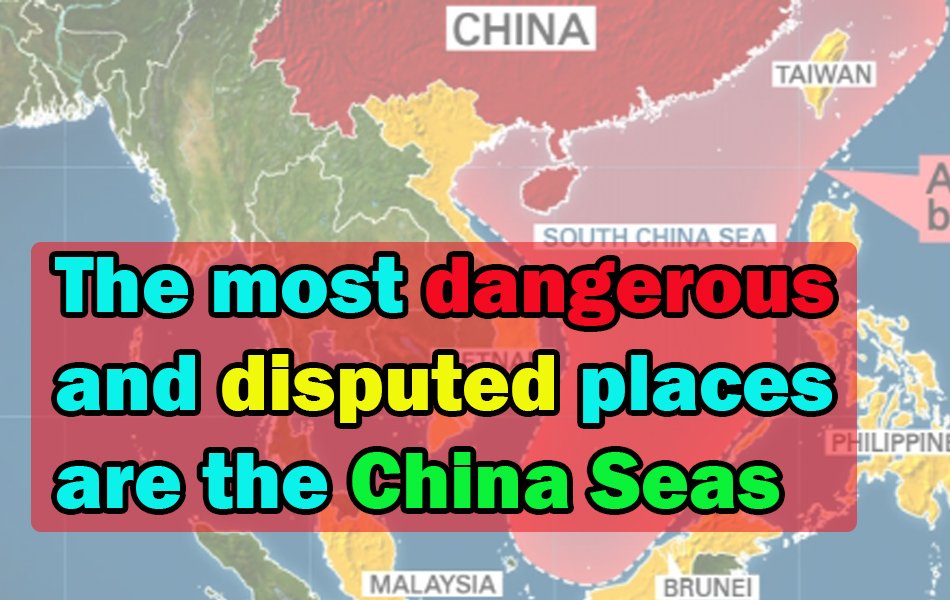
The China Seas—especially the South China Sea and East China Sea—are the most contentious and riskiest places in the world. According to The Observers, a war is likely to happen if all parties continue to provoke aggression against each other. It should be noted that the China Seas are the matter of life and death of Chinese strategic significance. These areas are the core interests of China’s security and geostrategic policies. If we check the maps meticulously, we will completely understand that China is the emerging superpower facing the hardest accessibility to the Pacific Ocean because the Chinese geopolitics is being surrounded by Japan and Taiwan in the east, and it is being in the strong contentions between China and other countries in the south in the South China Sea.
China also cannot access the Indian Ocean at its will through the South China Sea because it faces strong competition to take the hundreds of islands in the South China Sea, which are being contented by Vietnam, the Philippines, and Malaysia. It also should be noted that in previous centuries, China was a land power; on the contrary, it wants to become a sea power in the 21st century by building aircraft carriers, submarines that can launch nuclear attacks, and the drones to patrol the seas automatically. The China Seas, especially the South China Sea, are the foundations of the Chinese “one belt, one road,” which is an attempt to connect to the world’s major regions such as Southeast Asia, Africa, Europe, the Middle East, and South America, both through the sea and land routes.
Within the framework of the “One Belt and One Road” initiative, it is imperative that all maritime routes originate in the South China Sea, establishing connections to both the Indian Ocean and the Pacific Ocean. Consequently, it is of utmost importance and strategic significance for China to exert comprehensive control over the South China Sea. Historically and symbolically, the seas of China represent profound existential significance. It is essential to recognize that various historical adversaries and territorial challengers are converging around the China Seas, including Taiwan, Japan, India, the United States, Vietnam, and the Philippines.
Taiwan is the most dangerous geopolitical anxiety for China for the reason that Taiwan still continues to refuse to recognize the One China Policy. Japan has been the arch enemy of China historically and currently. India is a potential competitor and adversary of China in the region’s race for supremacy. The United States is the biggest threat to Chinese security and Chinese power for the reason that the United States sends the aircraft carriers on a regular basis to the Seas, which China is claiming.
Therefore, China has been trying to inculcate nationalism and pride among the people and leaders against these potential enemies for the sake of national unity and national unification to reduce the threats and emerge as the superpower. That’s why we see the Chinese nationalists on the mainland, in Hong Kong, and in Taiwan go to the conflicted island between China and Japan consequently to express their support for the Chinese government and against the Japanese government. The conflicted island was occupied by Japan in 1895 after China lost a war, and then it was occupied by the United States after the Second World War. Ultimately, the United States returned the island back to Japan in 1972.
The island has been claimed by China and Taiwan after the United States’ decision to return the island to Japan. However, Japan has always refused to handle the issue. The possibility for China to retake the island is very low for the reasons that the United States always commits to protecting Japan by using military intervention if war breaks out, and Japan itself also patrols the island regularly and meticulously.
On the other hand, China has the potential and possibility to claim the South China Sea. For instance, Paracel Island and the hundreds of small islands surrounding it have been almost totally occupied by China since 1974. There are only two contenders to occupy those small islands: China and Vietnam. For countries like the Philippines, Malaysia, and Brunei, they do not care about the Paracels and those small islands. And the one biggest island, which is surrounded by hundreds of small islands, is Spratly.
China and Vietnam want to totally occupy the island and those hundreds of small islands, while the Philippines, Malaysia, and Brunei only claim those small islands that are close to their borders. Comparing to the Paracel, which is being occupied almost totally by China, the Spratly is quite hard for China to completely dominate. Therefore, China has built an artificial island for its military bases, both naval and aircraft.
In conclusion, the China Seas are crucial for China’s security, trade, and geostrategic interests. The areas determine the destiny of China as a superpower. It is also one of the most dangerous geopolitical competitions, which can lead to the most catastrophic war that we have never seen in history. China will continue to assert its sovereignty and right to occupy. At the same time, the Chinese enemies will continue to prevent China from fully occupying the areas. The competitions will be more intense and fierce.
